Are Candles Safe for Cats? A Pet Owner's Guide
This guide is not veterinary advice. It's a plain-English summary of what veterinary sources say about candles and cats. If your cat shows signs of trouble - drooling, vomiting, wobbling, or breathing difficulty after exposure to a scented product - call your vet. The toxic-scent list below is sourced from Pet Poison Helpline's essential-oil guidance.
The short answer
An unscented candle made of plain wax is not a poison risk for your cat. The danger comes from two places: certain fragrance oils that cats cannot break down, and the open flame around a curious animal. Get the scent and the placement right, and a candle and a cat can share a room.
Why cats react differently than people (or dogs)
Cats are missing a liver enzyme that most other mammals have. That enzyme is what breaks down phenols and related compounds found in many plant oils. In a cat, those compounds build up instead. This is why a scent that smells fine to you - peppermint, citrus, eucalyptus - can poison a cat, especially if the oil gets on their fur or paws, because cats then lick it off while grooming. Scented candle wax is low-concentration compared to pure essential oil, so the main candle-related risk is breathing the fumes in a closed room or getting oil on skin and fur - but with cats, it's still worth taking seriously.
Wax types, ranked for cat homes
Soy wax - the best default. Soy burns cleaner than paraffin, produces very little soot, and the wax itself is non-toxic if a cat manages to eat a crumb (still call your vet if that happens). It also burns cooler, which matters if a paw or tail gets close.
Beeswax - good. Similar story to soy: clean burn, non-toxic wax. It's pricier and harder to mold, but there's no safety downside for cats.
Coconut wax - fine. Clean-burning and non-toxic. You'll mostly see it blended with soy in nicer candles.
Paraffin - the one to avoid. Paraffin is petroleum-derived. It burns hotter, throws more soot into the air, and can release irritants like benzene and toluene when burned. A paraffin candle in a ventilated room isn't an emergency, but if you own cats, there's no reason to pick it over soy or beeswax.
The wick matters too. Cheap imported candles sometimes still use lead-core wicks (lead wicks are banned in many countries, but they turn up in imports). Look for candles that say cotton or wooden wick. If a wick looks metallic in the center, don't buy it.
Scents to avoid around cats
These essential oils are listed by Pet Poison Helpline as known to poison cats: oil of wintergreen, oil of sweet birch, citrus oil (d-limonene), pine oils, ylang ylang oil, peppermint oil, cinnamon oil, pennyroyal oil, clove oil, eucalyptus oil, and tea tree oil (melaleuca). A veterinary hospital source adds lavender, thyme, and oregano to the avoid list for cats.
Most candle fragrance is synthetic rather than pure essential oil, and manufacturers don't have to disclose the full ingredient list - which is itself a reason for caution. The practical rule:
- Skip candles scented with the oils listed above. If the label says tea tree, eucalyptus, peppermint, citrus, pine, or cinnamon, don't burn it in a cat's house.
- Treat "lavender," "holiday spice," and "fresh linen" candles with suspicion unless the maker states they're phthalate-free and cat-safe. "Natural" on the label means nothing on its own.
- Unscented is the safest choice. A cat-shaped candle earns its keep on looks anyway.
Note that candles are a lower-exposure situation than diffusers or pure oils - no oil droplets land on surfaces from a burning candle the way they can from an active diffuser. The main routes that matter with candles are breathing strong fumes in a closed room and skin or fur contact with spilled wax or liquid fragrance.
Scents generally considered safer
No scent is proven zero-risk, and individual cats vary, but these are commonly listed as better-tolerated around cats at candle-level concentrations: chamomile (Roman), frankincense, cedarwood (Atlas), and rosemary. Even with these, keep the room ventilated and watch the cat - any coughing, watery eyes, or drooling means the scent goes out.
Try it: scent safety checker
Type a scent or essential oil below to check whether it's safe, risky, or toxic around cats.
How to burn candles safely with cats
The flame is the biggest everyday risk, not the wax.
- Burn where the cat isn't. A closed door beats any supervision plan. If the cat has to be in the room, burn the candle somewhere it can't reach - a high shelf with no launch pad nearby.
- Never leave a lit candle unattended. Tails and whiskers are flammable, and a knocked-over candle starts fires. This is the rule that prevents nearly all cat-plus-candle accidents.
- Ventilate the room. Crack a window or keep the door ajar. Don't burn scented candles in a small closed bedroom with the cat in it.
- Keep burn time short. One to two hours, then out. Longer burns mean more soot and more fumes for everyone in the room.
- Trim the wick to about 6mm (a quarter inch) before each burn. Long wicks make bigger flames and more soot.
- Don't put candles near curtains, shelves the cat jumps on, or anywhere at tail height. Cats knock things over; plan for it.
- Put the candle out if the cat shows interest. Pawing at the flame, sniffing the melt pool, chewing the wick - blow it out first, investigate later.
Special case: cats with asthma or any breathing trouble should not be around burning candles at all, scented or not. The smoke and particles can set off an attack.
What to do if your cat gets into a candle
- Burned a paw or singed whiskers? Cool the burn with lukewarm water for a few minutes and call your vet for anything beyond the lightest singe.
- Got hot wax on fur? Don't pull it - you can cut out the wax with blunt scissors (keep skin clear of the blades) or work it out with a little vegetable oil. Watch for red skin underneath.
- Licked scented wax or oil? Watch for drooling, vomiting, wobbling, or lethargy. If you see any of these, call your vet or an animal poison line right away - and bring the candle or its label so you can read off the scent ingredients.
- Got liquid fragrance oil on skin or fur? Wash it off with dish soap (like Dawn) and lukewarm water, then call your vet. Blue Lake Animal Hospital notes this as the standard first step before calling.
The zero-risk option: LED candles
If you want the look without any of the above, LED candles exist now in cat shapes too - some even flicker like real flames. No wax, no scent, no flame. For a household with kittens, elderly cats, or cats that chew everything, this is the honest recommendation.
Frequently asked questions
Is it safe to burn candles around cats?
Yes, with the right candle and habits: unscented or cat-safe-scented soy or beeswax candle, cotton wick, ventilated room, never unattended. Avoid the oils listed above, and skip candles entirely around cats with asthma.
Are soy candles safe for cats?
Soy wax itself is non-toxic to cats and burns cleaner than paraffin. The scent is what matters more than the wax - pick unscented or a cat-safe scent and check the wick is cotton, not metal-core.
Which candle scents are toxic to cats?
Tea tree, eucalyptus, peppermint, citrus, pine, cinnamon, wintergreen, sweet birch, pennyroyal, clove, ylang ylang, and lavender are the main ones veterinary sources flag. Unscented sidesteps the whole question.
Can cats be in the room with a lit candle?
They can, but a closed door is safer. If the cat is in the room, the candle should be somewhere unreachable, the room ventilated, and you present and watching. Blow it out the moment the cat gets curious.
Are cat-shaped candles safe for cats?
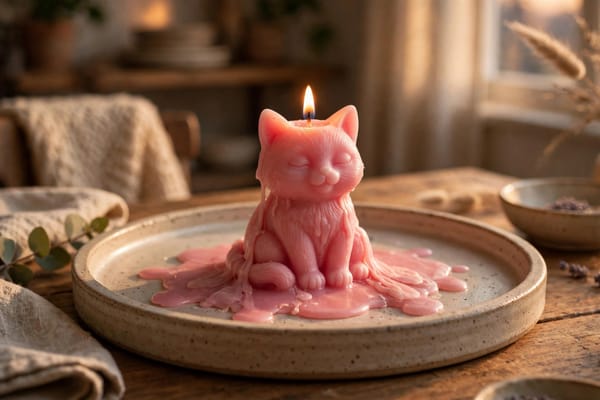
The shape changes nothing - it's the same rules. Use a soy or beeswax cat candle, unscented, cotton wick, and follow the placement rules above. Our step-by-step for making one: How to Make a Cat-Shaped Candle
Are candles or diffusers worse for cats?
Active diffusers that mist oil into the air are the worse of the two - they can leave droplets on fur and surfaces. A passive reed diffuser or a candle is lower exposure, but with the toxic oils, neither is safe.
Sources: Pet Poison Helpline, "Updates on Essential Oils" (essential oils known to cause poisoning in cats); Blue Lake Animal Hospital, "Holiday Scents and Pet Safety."