Best Candle Wax for Cat Owners: Soy vs Paraffin vs Beeswax vs Coconut Wax
The short answer
If you want one sentence: coconut wax and soy wax are the easiest good choices for a cat household, beeswax is excellent if it is refined and unscented, and paraffin is the one to skip.
Now the part most wax guides leave out. The scent in the candle matters more than the wax, and no wax makes a lit candle "safe" on its own. An unscented soy candle is a kinder choice for your cat than a strongly scented beeswax candle with a toxic oil in it. The wax ranking below still matters, because soot and smoke matter too, but it is the second question, not the first. The first question is always what the candle smells of.
Why cats are not small dogs (and not small people)
Cats are missing a liver enzyme called glucuronyl transferase, which humans and dogs use to clear certain compounds found in essential oils. That is why cats are so sensitive to phenols and phenolic compounds in some oils, and why the same candle that bothers nobody else in the house can bother the cat. The Merck Veterinary Manual makes the same point, and notes that tea tree oil has been the most commonly reported essential-oil intoxicant in pets.
There is a second route that dog pages miss. Cats groom themselves, so anything that settles on fur - soot, fragrance residue, spilled oil - gets licked off and swallowed. A candle can reach your cat through the air and through its own coat.
And a third: candle smoke is listed by the Cornell Feline Health Center among the suspected triggers of feline asthma, which affects a small share of cats. If your cat coughs or wheezes, the answer to "which wax" changes, and the honest answer may be no candle in that room at all.
Our full guide to candles and cats covers the liver-enzyme detail and the burn rules in depth. This page goes deeper on the wax itself. Start there if you want the whole picture: are candles safe for cats?
The four waxes at a glance
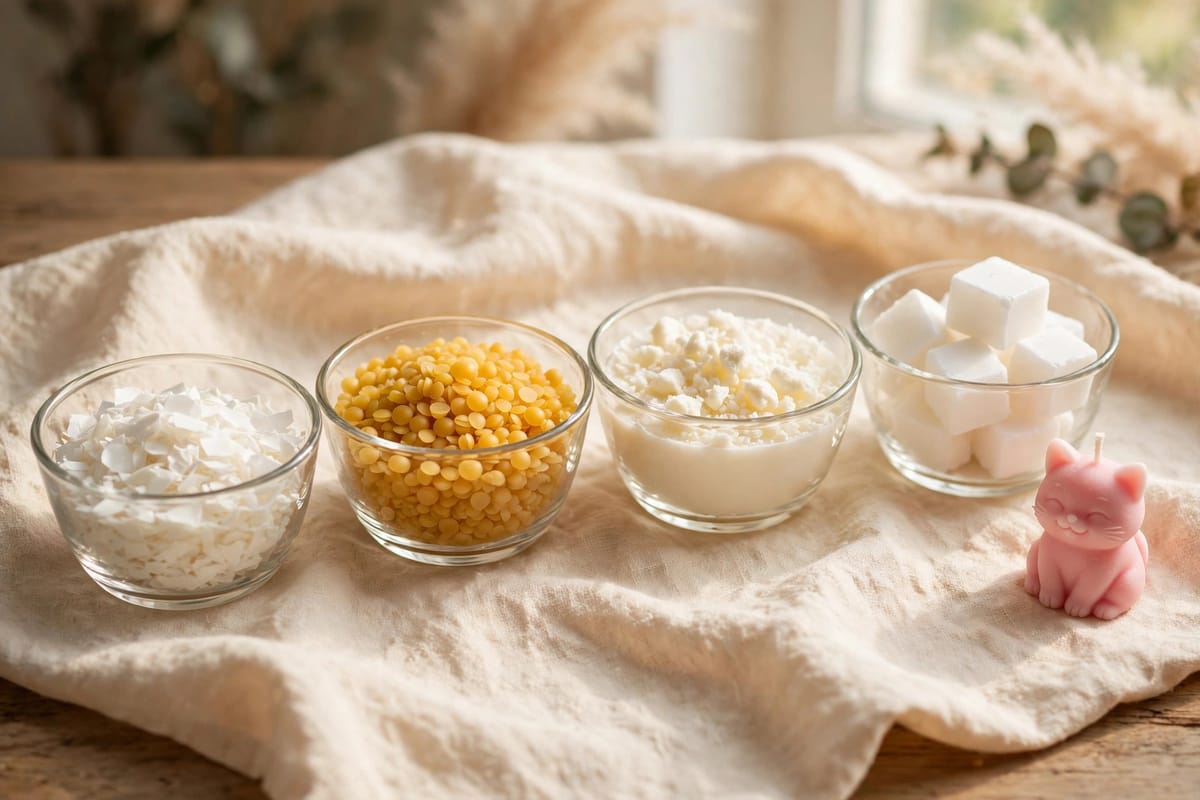
Here is the whole comparison on one screen. Each wax gets the same four cat tests: what it puts in the air, how much soot it makes, what happens if the cat licks it, and whether it holds a cat shape.
| Wax | Made from | Soot | Scent risk | If the cat licks it | Holds a cat shape? |
|---|---|---|---|---|---|
| Soy wax | Hydrogenated soybean oil | Less visible soot than paraffin when properly wicked | Depends on the fragrance, not the wax | Low toxicity in small amounts; still call the vet | Good in a jar; softer than beeswax for freestanding shapes |
| Paraffin wax | Petroleum refining byproduct | The most soot of the four | Can hold the most fragrance, so often strongly scented | Same mechanical risk as any wax; more soot to groom off fur | Good, which is why so many shaped candles use it |
| Beeswax | Secreted by honeybees, filtered | Very little soot | Lowest - holds the least fragrance, often unscented | Low toxicity in small amounts; still call the vet | Best of the four - highest melting point |
| Coconut wax | Hydrogenated coconut oil | Very little soot | Can carry a higher fragrance load, so check the scent list | Low toxicity in small amounts; still call the vet | Poor on its own - too soft; usually blended |
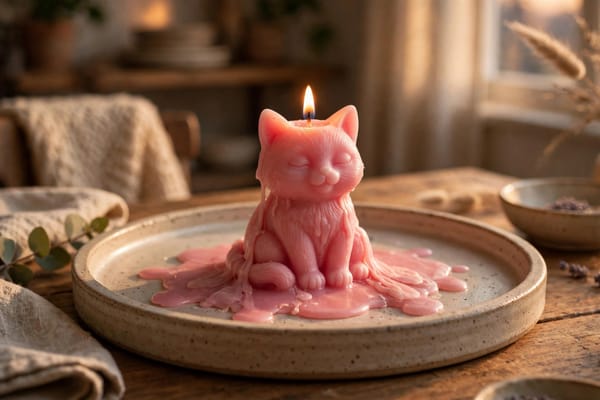
Melting points, for the makers reading: soy melts around 120 to 130 F, coconut around 124 to 127 F, paraffin anywhere from 115 to 154 F depending on the grade, and beeswax highest of all at 144 to 149 F. That is why beeswax holds a cat shape best and pure coconut wax struggles to. (If you have seen "soy melts at 180 F" somewhere, that is a heating or pouring figure, not a melting point.)
Ready to buy rather than compare? These are the cat candles we recommend, judged on wax, price, and fit.
Soy wax: the easy good choice
Soy wax is made from hydrogenated soybean oil, a renewable plant source. Burned with a proper wick, it generally produces less visible soot than paraffin. And plain soy wax itself is generally considered non-toxic to cats in small amounts - the risk sits in the fragrance, not the wax. That is why soy is the easy first candle for a cat household: unscented or lightly scented, in a jar, up high where the cat cannot reach it.
The catch is on the label. Many "soy" candles are soy-paraffin blends, sometimes up to half paraffin, sold as "soy blend". If you want soy, look for "100% soy wax" on the label. A candle that just says "soy blend" may be half the wax you were trying to avoid.
Soy is also the wax our DIY tutorial uses, because it pours well into a silicone cat mould and is easy to work with. If you want to make your own in the wax you have just chosen, start here: how to make a cat candle.
Best for: container candles, a first candle for a cat household, and DIY cat candles.
Paraffin wax: the one to skip (and what the famous study actually says)
Paraffin is a byproduct of petroleum refining, and it is in most shop-bought candles. When burned, it releases volatile organic compounds including benzene and toluene, and it produces the most soot of the four waxes here. That soot settles on surfaces, gets into fur, and gets ingested when the cat grooms.
You have probably seen the claim that paraffin candles release benzene and toluene while soy candles do not. It comes from a 2009 presentation by two researchers from South Carolina State University, who burned candles in a small sealed box - 8 by 8 by 26 inches - and found detectable benzene and toluene from paraffin, none from soy. Here is what the candle shops quoting it usually leave out: it was a conference presentation, never peer-reviewed, never published in a scientific journal, and it was funded by a USDA soybean research program under a grant called "Soybean Candles for Healthy Life and Well Being". The European Candle Association later called it "bad science" because of the abnormally small test chamber.
Peer-reviewed work since then found much smaller differences. Derudi and colleagues (2014) and Salthammer and colleagues (2021) found little difference in emissions between paraffin and natural wax candles, and found that added fragrance makes a bigger difference to emissions than the wax base.
So the honest position is this: the famous study is weak, and paraffin is still the worst of the four for a cat household. Not because one paraffin candle poisons a cat - a well-made paraffin candle burned properly in a ventilated room is not poison in a single evening. But paraffin is petroleum-based, it makes the most soot, and your cat lives in that room all day, breathes faster for its body weight than you do, and cannot clear some of these compounds well. The safer waxes cost little extra. That is reason enough to skip it for everyday burning.
One more thing in paraffin's favour, said plainly: it holds a cat shape well and holds the most fragrance oil, which is why cheap scented candles smell so strong and why so many shaped candles are made from it. If you already own a paraffin cat candle, burning it occasionally in a ventilated room, out of the cat's reach, is not a crisis. Just do not make it your everyday candle.
Beeswax: best for cat shapes, with one catch
Beeswax is secreted by honeybees, then filtered and moulded. It needs no hydrogenation or bleaching, it is naturally golden, and it has a faint honey smell of its own - which is not an essential oil, so it does not carry the essential-oil risk. It burns with very little soot, and because it holds the least fragrance oil of the four waxes, beeswax candles are often unscented or lightly scented. For a cat household, that is a plus, not a drawback.
The catch is refined versus unrefined. One seller who ranks waxes for cats puts unrefined beeswax in the "avoid" column, because raw beeswax can contain pollen, propolis, and other plant residues that irritate some cats. Refined beeswax is the better buy. If a listing just says "beeswax" and does not say refined, ask the maker, or pick one that does.
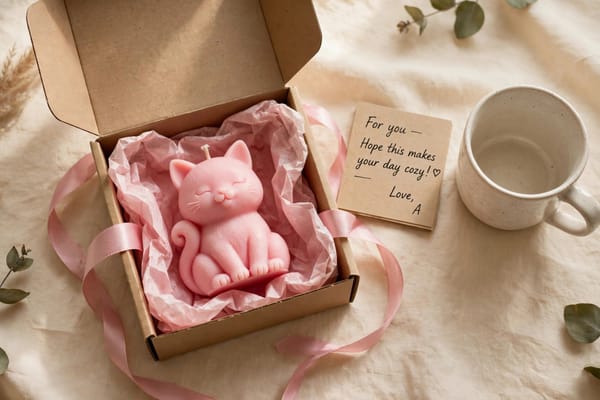
Beeswax also has the highest melting point of the four, which makes it the best wax for a freestanding cat shape: it holds its form, keeps a smaller melt pool, and tends to burn longest. If you want to pour your own cat candles, a soy-beeswax blend is a good middle ground - see how to make a cat candle.
What we will not claim: you may see beeswax sold as releasing "negative ions" that purify the air. No peer-reviewed source backs that up, so we do not repeat it. Beeswax earns its place here on soot and shape, not on air purification.
Best for: cat-shaped and other freestanding candles, and anyone who wants an unscented candle with a natural honey smell.
Coconut wax: the cleanest burn, the softest candle
Coconut wax is made from hydrogenated coconut oil. It is not coconut oil - coconut oil liquefies around 76 F and is not a candle wax at all. Most jars labelled coconut are actually coconut-soy or coconut-apricot blends, which is worth knowing before you compare prices.
Sellers who rank waxes for cats put coconut wax at the top: very little soot, low emissions, a gentle burn. One honest caveat: the seller ranking it highest sells coconut-apricot candles, so treat that ranking as one seller's view, not a vet verdict. The cleaner-burn part is widely agreed; the "safest" crown is marketing.
The real catch is shape. Pure coconut wax is soft and creamy, so on its own it is a poor choice for a freestanding cat-shaped candle. It is usually blended with soy or beeswax for anything that has to stand up. And because coconut wax can carry a higher fragrance load than soy, a coconut candle can smell stronger than you expect - which is a reason to check the scent list carefully rather than assuming coconut means gentle.
Best for: container candles and wax melts in a warmer, where softness does not matter.
What about the scent? (this is the section that saves the article)
Short version: an unscented soy candle is safer for a cat than a strongly scented beeswax candle with a toxic oil in it. If you remember one thing from this page, make it that.
Pet Poison Helpline lists these 11 oils as known to poison cats: tea tree, eucalyptus, peppermint, citrus (d-limonene), pine, cinnamon, wintergreen, sweet birch, pennyroyal, clove, and ylang ylang. If a candle's scent list names any of them, do not burn it in a cat's home, whatever the wax is. Signs of essential-oil poisoning in cats include drooling, vomiting, tremors, wobbliness, trouble breathing, and a low heart rate; severe cases can lead to liver failure. First step is fresh air and the candle out, then a vet. Pet Poison Helpline's 24/7 line is (855) 764-7661, and the ASPCA Animal Poison Control Center is (888) 426-4435.
Lavender deserves its own honest paragraph, because it is the scent cat owners ask about most. The ASPCA lists the lavender plant as toxic to cats. Pet Poison Helpline's list of oils known to poison cats does not include lavender oil. Both things are true, and they disagree because they are talking about different things: the plant versus the oil, and concentration matters. Some sellers call lavender pet-safe; others sell lavender fragrance-oil candles (a fragrance oil is not lavender essential oil). Our position: skip lavender-scented candles around cats. A label will not tell you which form was used, and there are plenty of scents nobody argues about.
Fragrance oil versus essential oil, in one paragraph: essential oils are concentrated plant extracts, and most of the poisoning guidance was written about concentrated oils and diffusers, not candles. A burning candle releases far lower concentrations than a diffuser. Fragrance oils are made for candles and can be formulated without the risky compounds - but "fragrance oil" on a label does not guarantee that, and "natural" does not either. What matters is the actual ingredient list. When in doubt, unscented wins.
Our full safety guide covers the burn rules that go with any scented candle. And if you want to check a specific scent, the checker below uses the same lists as this article.
Try it: scent safety checker
Type the scent on your candle's label and get the verdict from our safety lists. If a scent is not on the lists, the checker says so instead of guessing.
If your cat licks or eats wax
Plain soy, beeswax, and coconut wax are low toxicity in small amounts. A small lick of plain wax is unlikely to cause toxic effects. But no wax is "safe to eat": a large amount can cause vomiting, diarrhoea, constipation, and intestinal blockage, especially from large pieces. Those are mechanical digestive problems, not poisoning, but they still need a vet.
A container candle adds two extra hazards if eaten: glass from the jar and the small metal tab at the base of the wick. Scented wax adds the fragrance question on top.
If your cat eats any part of a candle: move the candle away, check the mouth and paws for burns if the wax was hot, and call your vet. Do not try to make the cat vomit unless the vet tells you to. The safety pillar has the full what-to-do steps: candles and cats safety guide.
How to read a candle label in 30 seconds
This is the part to use in a shop. Five checks, in order:
- The wax line names the wax. "100% soy wax", "beeswax", or "coconut wax" - not just "blend" with paraffin hiding in it, and not just "natural".
- The scent line is honest. It names the fragrance and says phthalate-free, or it says unscented. If it names tea tree, eucalyptus, peppermint, citrus, pine, cinnamon, wintergreen, sweet birch, pennyroyal, clove, or ylang ylang, put it back.
- The wick is cotton or wood. Lead-core wicks were banned in the US in 2003, but other metal-core wicks (zinc, tin) are still common. Health Canada advises against burning any candle with lead in the wick. If you are not sure, ask the retailer.
- "Non-toxic" is not doing all the talking. There is no agreed definition of "non-toxic" for candles and no regulator certifies it. It is marketing language, not a safety designation. A candle that only says "non-toxic" and nothing else has told you nothing.
- The maker is specific. A good label reads like a recipe: wax, wick, fragrance, burn guidance. A vague label ("natural, pet safe, clean burning") is hiding the details you actually need.
Found a candle that passes all five? Our best cat candles roundup is where we put our own picks through the same checks.
Which wax for your house?
- Healthy adult cat, big ventilated room: any of the three good waxes, unscented or lightly scented with a safe scent. This is the easy case.
- Kitten, or a very curious cat: unscented, up high, never left lit and unattended - or keep the candle unlit as decoration.
- Cat with asthma or breathing trouble: no scented candles in the cat's room. Talk to your vet. A wax warmer (no flame, no soot) or no candle at all may be the right answer.
- Small flat or closed bedroom: shorter burns, open a door, or skip the flame and use a warmer. A wax melt in an electric warmer has no combustion, so no soot - but the scent question still applies.
- You want to make cat-shaped candles: soy or a soy-beeswax blend, per our DIY tutorial, because pure coconut wax is too soft to hold a cat shape and paraffin is the wax to avoid.
Try it: safe wax finder
Answer three questions - wax, scent, and your house - and get a plain verdict. If the label does not tell you the wax, the tool says so instead of guessing.
Quick answers
Is soy wax safe for cats?
Plain soy wax is generally considered non-toxic to cats in small amounts, and it burns with less visible soot than paraffin when properly wicked. The risk is in the fragrance, not the wax. Check the label says "100% soy", not "soy blend".
Is paraffin safe for cats?
Paraffin is the one to skip for everyday burning: petroleum-based, the most soot, and it releases benzene and toluene when burned. A well-made paraffin candle burned properly now and then is not poison, but soy, beeswax, and coconut are better everyday choices.
Is beeswax safe for cats?
Refined beeswax is a good choice: very little soot, often unscented, and its honey smell is not an essential oil. Unrefined beeswax can carry pollen and propolis that irritate some cats, so buy refined.
Is coconut wax safe for cats?
Coconut wax burns clean with very little soot, and plain coconut wax is low toxicity in small amounts. It is too soft on its own for a cat-shaped candle, and it can carry more fragrance, so check the scent list.
Can I burn a candle in the same room as my cat?
Yes, with the usual rules: out of reach, on a stable surface, in a ventilated room the cat can leave, never left unattended, and never a scent from the toxic list. A cat with asthma is the exception - ask your vet.
What if my cat eats a candle?
Move the candle, check for burns if the wax was hot, and call your vet. Small amounts of plain wax are low toxicity, but large amounts can block the gut, and a jar candle adds glass and a metal wick tab. Do not make the cat vomit unless the vet says so.
Sources
- Pet Poison Helpline, essential oils and cats (the 11-oil list and poisoning signs), via Rexvet's summary of Pet Poison Helpline and the Merck Veterinary Manual.
- Titan Candles, "Are Candles Bad for Cats and Dogs? A Pet Owner's Guide", citing Pet Poison Helpline, Cornell Feline Health Center, and Health Canada.
- ASPCA lavender listing (Lavandula angustifolia toxic to cats), via Lowlight Leaf's summary of the ASPCA entry.
- Unscented Candle Company, "The 'Non-Toxic Candle' Myth", on the 2009 South Carolina State study and the later peer-reviewed work (Derudi et al. 2014; Salthammer et al. 2021).
- Bottlenose Candles, "Is Soy Wax the Safe Choice for Your Home with Pets and Kids?" (soot wording, wax-if-eaten, the well-made paraffin counterpoint).
- MBur Candle Co., "Are Scented Candles Safe for Cats?" (soot and grooming route, wick metals) - a beeswax seller, read with that in mind.
- Bee Coco, "Coconut-Apricot Wax Safest for Cats and Dogs" (refined vs unrefined beeswax) - a coconut-wax seller, read with that in mind.
- GODONLIF, "Candle Wax Melting Point by Wax Type" (the melting-point table).
- Royal Flame Candle Co., "Are Soy Candles Safe for Dogs and Cats?" (fragrance concentration, wax melts).